From On-Control Programming to Collision-Free Machining
Key Highlights
- Digital twins and simulation have transformed machining process planning, but the digital workflow often ends once the NC program reaches the shop floor.
- CHIRON Group and ModuleWorks collaborate to integrate on-control programming, digital twins, and real-time collision avoidance directly into CNC controls, streamlining production.
- Shop floor programming is now more accessible with intuitive touchscreen interfaces, enabling operators to program directly at the machine and reduce reliance on offline CAM processes.
- Feature-based programming helps identify geometric features and guides machining operations, improving efficiency for both experienced and less experienced operators.
- Embedding digital workflows into CNC controls enhances flexibility, shortens setup times, and minimizes errors in high-mix, low-volume manufacturing environments.
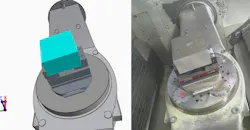
Digital twins, simulation and CAM have fundamentally changed the way machining processes are planned. But once the NC program reaches the shop floor, the digital workflow often ends. Programming adjustments, set-up and machining frequently rely on manual intervention which adds time and creates opportunities for errors. For production managers and NC programmers in high-mix, low-volume environments, unexpected collisions can mean more than repair costs. They can result in hours or even days of downtime and missed delivery deadlines.
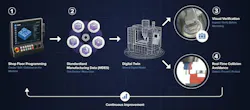
Machine tool builders are therefore looking at ways to bring the digital process chain onto the production floor. One example is the collaboration between CHIRON Group and ModuleWorks, which combines on-control programming, a digital twin, camera-based machine verification and real-time collision avoidance in an end-to-end shop floor workflow.
Bringing programming closer to production
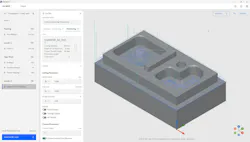
The first step in bringing the digital workflow to the shop floor is to move programming closer to production. Rather than creating an offline CAM program for every new part, CHIRON has integrated ModuleWorks Next Generation Shopfloor Programming (NGSP) directly into the CNC control.
Using an intuitive touchscreen interface, operators program directly at the machine without manually writing G-code. Feature-based programming identifies geometric features such as holes, pockets and planar areas, and uses this information to guide the selection of machining operations and cutting parameters. Direct access to the tool database also helps operators select suitable tools for each machining operation.
This makes digital intelligence available where production decisions are made: directly on the shop floor. Experienced users can reach finished G-code more quickly, while less experienced operators are guided through the programming process.
For machine shops producing a wide variety of parts in small batch sizes, this can help shorten set-up and response times and increase flexibility in daily production, making it easier to process new jobs without placing additional demands on the CAM department.
Keeping the digital workflow connected
Programming alone does not guarantee safe machining. The manufacturing information generated during programming must also be available to downstream systems for process validation and machine protection.
After creating the NC program, the operator exports it together with all relevant machining data using the Manufacturing Data Exchange Specification (MDES), a standardized specification for exchanging manufacturing information between different software systems. This information is transferred to CHIRON ProtectLine, where it is integrated into a digital twin of the machining process.
MDES ensures that the same manufacturing definition — including tools, machining operations and workholding set-up — is used for both programming and machine protection. The operator does not have to recreate this information in the protection system after programming. The digital twin then accurately represents the machining set-up, combining the machine kinematics, tools, workholding and workpiece in a single virtual model.
This model serves as a common reference for subsequent machine verification and collision protection.
Bridging digital model and actual machine set-up
Even the most accurate digital twin cannot compensate for an incorrectly set up machine. Small discrepancies between the planned and actual workholding set-up are among the most common sources of errors in day-to-day production.
To reduce this risk, CHIRON uses a camera-based validation system designed to improve machine safety and prevent set-up errors, whether caused by human error or, in automated production environments, by robotic systems.
During set-up, a camera monitors the machine's working area. It assists the operator in checking key aspects such as the position of the raw material, workpiece clamping and any foreign objects in the work area — from tools accidentally left inside the machine to other objects that should not be there.
Based on the digital twin, the system generates a reference image from the same perspective as the installed camera. Before machining begins, this reference image is compared with a live image of the actual machine.
Production starts only after the operator has approved the set-up. From this point onward, CHIRON ProtectLine provides real-time protection during the machining process.

Detecting collisions before they occur
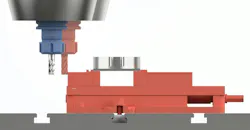
During machining, the protection system continuously predicts future machine movements using look-ahead data from the CNC control together with the digital twin. This capability is provided by the ModuleWorks Collision Avoidance System (CAS), which calculates the future positions of the spindle, tools, workholding, workpiece and machine components to identify potential collisions at an early stage.
Unlike conventional simulation, which validates an NC program before production starts, CAS continuously looks ahead during machining using the digital twin. If the system detects an impending collision, machining is stopped before physical contact occurs.
The camera system and CAS therefore complement each other. Before machining begins, the camera verifies that the actual machine set-up matches the digital twin, while CAS protects the machine during the machining process.
Extending the digital process chain
Shop floor programming, digital twins, machine verification and collision avoidance each address different challenges. Their real value, however, comes from combining them in a single workflow.
In the workflow presented here, programming takes place directly at the machine. Manufacturing data is transferred digitally to the protection system, the digital twin is compared with the actual machine set-up and machining is then protected by intelligent collision avoidance.
Extending the digital process chain beyond the engineering phase and into production can improve process reliability by reducing set-up errors and minimizing downtime, making high-mix, low-volume manufacturing more efficient.
As production becomes increasingly digital, integrated shop floor workflows of this kind are likely to become more important. The collaboration between CHIRON Group and ModuleWorks demonstrates how digital twins, standardized manufacturing data, intuitive shop floor programming and intelligent machine protection can work together to support a safer, more flexible machining process.
About the Author
Miguel Tobias Johann
Product Director
Miguel Tobias Johann is the product director at ModuleWorks, a software developer of backend components, algorithms, and simulation kernels for computer-aided manufacturing (CAM) and computer-aided design (CAD) systems.