Smart Nesting Is the Starting Point for Laser Cutting
Key Highlights
- CAM nesting software automates part arrangement to maximize material use and minimize waste, improving overall efficiency.
- Proper part placement and sequencing help distribute heat evenly, reducing distortion and thermal damage during laser cutting.
- Support geometry and spacing considerations are crucial to prevent part movement and collision risks as material is removed.
- Optimizing nesting for both material utilization and cutting performance can significantly reduce cycle times and scrap rates.
- Planning for unattended cycles involves ensuring process stability through digital design, heat management, and collision avoidance, supported by sensor backups.
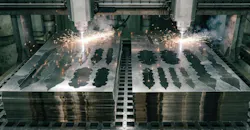
Just like turning or grinding, laser cutting two-dimensional parts requires a plan, to define the cutting sequence in the most effective, most efficient, and safest way. Computer-Aided Manufacturing for laser cutting calls for nesting software, to automate the process of arranging part profiles onto a blank sheet of material (metal, plastics, wood, even fabric), to maximize material use and minimize waste. CAM nesting software calculates the ideal layout before generating a G-code pattern for CNC cutting.
There are other parallels to CNC machining, like cutting head collisions. In 2D cutting, a crash often begins before the collision, if the parts become unstable, or the cutting pattern leaves a weak “skeleton,” or the process heat is too concentrated. CAM nesting software can help avoid these outcomes by defining part location, heat distribution, and cutting sequence before unattended laser cutting begins.
More than that, the current state of this technology is “smart nesting” - which not only arranges the part profiles but optimizes layouts to reduce material waste, shorten cutting paths, and maximize the number of usable components per sheet.
Treat the nest as a process-control layer
Lean manufacturing targets waste at its source rather than relying on downstream inspection. The U.S. Environmental Protection Agency identifies defects, waiting, excess inventory, unnecessary movement and overprocessing among the wastes addressed by lean methods. A nest that creates a distorted part, an unstable remnant, or a collision condition has waste already built into the process.
Smart nesting optimizes more than sheet utilization. A dense nest can be operationally poor if it concentrates heat, leaves narrow bridges, or causes finished parts to tip into the cutting path.
Control heat before it creates distortion
Thermal accumulation makes nesting more than a two-dimensional packing problem. Laser cutting introduces localized heat, and closely grouped cuts can limit how effectively that heat dissipates. A study on sheet-metal laser cutting examined distortion and excessive melting caused by heat accumulation and considered machining paths and process parameters.
For programmers, the implication is direct. Part placement and cut order should work together. Thermally intensive features can be distributed across the sheet rather than cut consecutively in a single region. Heat-sensitive geometries can be sequenced too, to give the material more time to dissipate energy.
This matters even more when no operator is present. A warped part can become a collision risk, while a distorted thin section can alter how the remaining skeleton supports neighboring components.
Keep parts mechanically predictable
Tight layouts may improve utilization, but minimum spacing is not always optimal. As cutting progresses, narrow connections, long unsupported edges, and poor placement can leave the skeleton vulnerable to movement. A finished component may lift or rotate into the cutting head’s path.
Part size relative to cutting-bed slat spacing can create another tip-up risk. When a newly cut component is smaller than the spacing between supporting slats, it may not remain securely supported. One edge can drop while another pivots upward into the cutting head’s travel path, with high-pressure assist gas potentially worsening the instability.
This makes support geometry an important nesting consideration. A reliable nest accounts for how each component will be supported as surrounding material is removed.
A 2024 study of sheet-metal nesting algorithms tested an approach against 332 industrial laser-cutting samples. It reported 98.5% accuracy while reducing the average computation time to 23.8% of the comparison algorithm.
Advanced nesting can evaluate geometric relationships that are difficult to reproduce consistently through manual placement. A smart nest should preserve structural integrity by avoiding fragile slivers and considering how the skeleton will support parts as material disappears.
Optimize the cut, not just the sheet
The strongest nesting strategies for laser cutting treat material utilization and cutting performance as linked objectives. A dense nest can reduce raw material waste while increasing travel distance, pierce count, or thermal concentration.
A recent industrial study involving AISI 304 stainless-steel sheets found that automatic nesting increased parts per sheet from 44 to 76, reduced unused sheet area from 61% to 39% and shortened cutting time from 12 to 9 minutes. It also reported approximately 36% lower material waste for the analyzed batch.
The lesson is that maximum density does not automatically produce the best result. Nesting should be optimized against parts per sheet, cutting time, scrap, heat exposure, remnant quality and process stability.
Design for the unattended cycle
Modern fabrication uses digital tools such as computer-aided design and building information modeling to define component requirements before cutting. Nesting carries that digital planning into production by determining how those components will be arranged and processed on the sheet. For unattended cutting, the planning must account not only for dimensional accuracy but also for how the material and parts will behave throughout the cycle.
Unattended cutting changes the programmer’s risk calculation. During an attended run, an operator can spot a shifting part or an abnormal condition and intervene. An unattended process has fewer opportunities for intervention, making predictable machine and material behavior more important.
The programming objective should be whether the nest will remain stable throughout the cycle. Key checks include thermal distribution, part stability, cut order, feature placement, remnant behavior and collision exposure. Each consideration helps reduce conditions that could interrupt the process or affect finished-part quality.
This preventive approach also supports lean manufacturing objectives by moving quality control earlier in the production process. A well-planned nest can account for potential instability before cutting begins, reducing the likelihood that defects, interruptions or machine downtime will require corrective action later.
Make sensors the backup
Collision detection and machine safeguards remain essential. They will provide a margin of safety if (or when) the real-time conditions escape the process plan. But relying on reactive systems to compensate for a weak nest reverses the hierarchy of control.
A 2022 study demonstrated a real-time monitoring approach for high-power, fiber-laser cutting using InGaAs and Si photodiodes integrated into the cutting head. In its cutting-monitoring method, the system detected signals associated with poor-quality cuts and could retrace part of the cutting path, reduce cutting speed by 15% or change gas pressure, then attempt the cut again. If a weak cut persisted after two interventions, the process was stopped.
Smart nesting addresses root conditions first, determining part placement, support, heat distribution and cutting sequence. Sensors provide backup if conditions diverge from the programmed model. This matters for lean operations, as avoiding collisions can prevent downtime, scrap, reprogramming, delays, and excess handling.
Effective nesting strategies for laser cutting treat material utilization and process reliability as one programming objective. A well-designed nest can address instability before cutting begins, making computer-aided manufacturing programming an early control point for quality, uptime, and predictable performance.
About the Author
Emily Newton
Emily Newton is the Editor-in-Chief of Revolutionized, an online magazine exploring the latest industrial innovations.