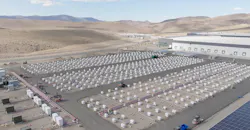
Electric vehicle manufacturer Rivian Automotive has struck a partnership with Redwood Materials to build a battery energy-storage plant adjacent to its Normal, Ill., EV assembly plant, to draw up to 10 megawatt-hours of electrical energy from more than 100 second-life Rivian battery packs.
Redwood Energy is a division of Redwood Materials, a business founded by former Tesla chief technology officer J.B. Straubel. The parent company develops and manages large-scale energy-storage systems. The company produces lithium, nickel, cobalt, copper, and cathode active material, and manufactures critical components for advanced batteries, while Redwood Energy deploys energy-storage systems that power data centers and electrical grids.
Stationary energy-storage is an increasing common strategy for manufacturers and utility companies to reduce electrical cost and increase stability for customers and grids. In their announcement, the partners project that Rivian will be able to “instantly deploy energy stored in its second-life batteries to offset increased strain on the grid, avoiding having to purchase more expensive electricity while also avoiding additional load on the power system.”
"Electricity demand is accelerating faster than the grid can expand, posing a constraint on industrial growth," Redwood Materials CEO Straubel offered. "At the same time, the massive amount of domestic battery assets already in the U.S. market represents a strategic energy resource. Our partnership with Rivian shows how EV battery packs can be turned into dispatchable energy resources, bringing new capacity online quickly, supporting critical manufacturing, and reducing strain on the grid without waiting years for new infrastructure. This is a scalable model for how we add meaningful energy capacity in the near term."
The Normal, Ill., plant produces Rivian’s R1T pickup truck and R1S SUV. It also produces a line of electric light-commercial vehicles, including Amazon delivery trucks. In 2024 it announced an expansion to add assembly of its R2 midsize electric SUV, based on a new midsize vehicle platform.
R2 production is expected to ramp-up in Normal by midyear.
At a site near the central Illinois assembly plant, Rivian will provide EV battery packs to Redwood, which will integrate them into a system based on its Redwood Pack Manager technology, allowing the stored energy to be used on-site by Rivian’s operations.
According to the new partners, the Redwood technology is rapidly scalable and offers cost benefits by using safe and proven EV batteries. It claims this approach enables faster, more flexible deployment of energy capacity directly at high-demand sites like manufacturing facilities.
Redwood Energy’s storage system uses a proprietary "Pack Manager" technology that functions as a universal translator for various EV battery types to establish modular, open-air storage arrays that operate at lower power rates compared to their initial use, which reduces maintenance cost.
Reportedly, such a set-up can be deployed as quickly as six months.
The partners’ announcement did not indicate their capital investment cost nor the start-up schedule for the energy-storage plant.
Rivian R1 vehicles are powered by a high-voltage, liquid-cooled lithium-ion energy-storage system, designed as a package of cylindrical cells arranged in modules. Second-life battery packs are those that have reached the end of their useful life in an EV but retain about 70–80% of their original capacity.
“EVs represent a massive, distributed and highly competitive energy resource," stated Rivian CEO R.J. Scaringe. “As energy needs grow, our grid needs to be flexible, secure, and affordable. Our partnership with Redwood enables us to utilize our vehicle’s batteries beyond the life of a vehicle and contribute to grid health and American competitiveness."
About the Author
Robert Brooks
Content Director
Robert Brooks has been a business-to-business reporter, writer, editor, and columnist for more than 20 years, specializing in the primary metal and basic manufacturing industries.