The Orders Are In. Can the Shop Afford the Next Machine?
Key Highlights
- The modeled cell adds about 750 good parts per month, but a job-specific cycle-time trial and checks on handling, inspection, and shipping capacity must validate the forecast.
- The $340,000 project budget includes the configured cell, site preparation, tooling, programming and training; the machine allowance is provisional, not a supplier quote.
- At steady output, the expansion contributes $9,250 monthly after variable costs, staffing, and financing payments; at 50% growth, that falls to just $500.
- With customers paying one month after shipment, peak project cash required reaches $194,000, and cumulative cash recovery occurs in month 25 under the stated assumptions.
- A one-month commissioning delay raises peak cash required to $211,000 and moves recovery to month 28, underscoring the need to protect the existing shop’s operating reserve.

The owner has landed three more contracts. That is the good news. On the shop floor, every available machining hour is already spoken for. Adding the work to the schedule means pushing another customer's delivery date, paying for outside capacity or buying equipment.
In this hypothetical shop, a new CNC machining center paired with a tending robot looks like the way forward. The owner budgets for 75% sales growth after the cell reaches steady production. Before signing the purchase order, he needs to connect that forecast to a production schedule: How many additional good parts can the cell ship, and how long before that work starts putting cash back into the business?
That is a useful place to start. The contracts explain why he wants the machine. They do not pay for its installation.
Buy the capacity that the orders need
For the planning exercise, the shop currently ships 1,000 good parts per month at an average selling price of $100, producing $100,000 in monthly sales. The reference equipment is a Haas VF-2SSYT machining center with a TRT160 rotary and Robot Package-1, a combination Haas lists on its configured automation packages page. The machine's product page is linked separately.
The forecast starts with one eight-hour shift over 20 working days: 160 scheduled hours. Allowing 20% for set-ups, tool changes, maintenance, and interruptions leaves 128 productive hours. With a 10-minute combined machining-and-handling cycle and a 98% acceptance rate, which yields about 753 good parts. The owner rounds down to 750, or $75,000 in added monthly sales. Total shop sales reach $175,000, a 75% increase.
That is a job-specific planning calculation, not a Haas output rating. A cycle-time trial on the intended parts must establish whether 10 minutes is achievable with the selected tools, fixtures, and loading sequence. The parts also must fit the rotary, work envelope and robot's handling limits. An eight-hour schedule does not assume overnight unattended production.
The owner and production manager should review the actual part families with the supplier. They need inspection, deburring, and shipping capacity for the additional 750 parts, too. Purchasing and accounting must confirm material availability, customer releases and payment terms. If any of those checks fails, the forecast comes down before the purchase is approved. Mapping the full route through the shop helps expose those dependencies. NIST's Manufacturing Extension Partnership describes value stream mapping as a way to visualize material and information flows, diagnose problems, and plan improvements across departments.
The machine is only part of the purchase
The project budget retains a $340,000 spending ceiling: $300,000 for the configured machine, rotary, and robot cell; $15,000 for rigging, utilities, and site preparation; $15,000 for additional job-specific tooling and workholding; and $10,000 for application programming, prove-out, and training. The robot is included in the cell allowance, not added to a bundled machine price a second time.
For context, Haas lists a $237,773 retail price for its VF-2SSYT/TRT160/robot package. The $300,000 allowance for the cell is a provisional ceiling above that reference, not a supplier quote. A current configuration and delivered-price proposal should replace it; unused allowance reduces the investment.
These are the shop's assumed project allowances. Before committing, the owner needs written scopes that settle who supplies the gripper, guarding, fixtures, software, and commissioning work. Taxes, freight and other applicable charges need a place in those scopes or the budget. An uncovered item is additional cash; however small it may seem beside the machine price.
Here, equipment financing supplies $240,000 of the equipment purchase. The shop supplies the other $100,000 at the start. The cash model uses a $5,000 monthly financing payment, beginning in the installation month. Actual proposals must supply the term, fees, total repayment, and any final payment before the owner can judge the borrowing cost. An equipment-financing checklist published on the SBA website also advises comparing rates, lease terms, fees, and available options rather than assuming the bank or machine manufacturer offers the best terms.
The operating budget adds $12,000 per month for staffing and support costs, beginning immediately. Variable production costs consume 65% of added sales. Those costs include the incremental material, consumables, and other volume-related spending; the staffing allowance is counted separately. Existing shop expenses remain in the existing business forecast.
Make the first shipment earn its place
Assume installation goes smoothly. Month one is reserved for installation and commissioning. Added sales reach $20,000 in month two, $45,000 in month three and $75,000 in month four. The shop then holds that additional monthly volume.
At the planned output, the extra $75,000 of sales produces $26,250 after variable costs. Subtracting the $12,000 staffing and support allowance leaves $14,250 before financing payments. After the $5,000 payment, the expansion contributes $9,250 a month in cash once customer receipts have caught up with shipments.
At 50% sales growth, the arithmetic is much tighter. Another $50,000 in sales produces $17,500 after variable costs, leaving just $500 after the same $12,000 allowance and $5,000 payment. The shop owner should know that before treating the low end of his forecast as comfortable.
The monthly sales needed to cover those two cash obligations are about $48,600: $17,000 divided by the 35% contribution margin. That calculation assumes customers pay and the costs behave as budgeted. It does not show when the cash arrives.
Watch the month between shipping and collecting
In this example, customers pay in the following month, while production costs are paid in the month the parts ship. Month two therefore brings $20,000 of added sales but no collections from that work. The shop pays $13,000 in variable costs, $12,000 in staffing and support, and the $5,000 financing payment. Another $30,000 leaves the bank.
The same timing problem continues as production grows. Month three collects $20,000 against $46,250 of costs and payments. Month four collects $45,000 against $65,750. By the end of month four, the project has used $194,000 of the shop's cash, including its original $100,000 contribution.
That is almost twice the check the owner wrote at the start.
The financing can cover the equipment balance while leaving this operating cash requirement entirely with the shop.
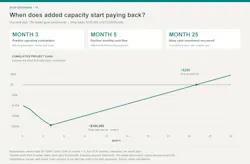
The first infographic separates three milestones. Month three produces a positive operating contribution after the added staffing and support costs. Month five produces the first positive monthly cash flow after financing payments. Cumulative project cash finally turns positive in month 25, assuming the extra sales continue at $75,000 a month.
Payment terms deserve attention before the first shipment. If a customer requires inspection approval before the invoice clock starts, shipping in month two may not mean collecting in month three. Accounting should confirm that trigger with the customer. Then, the shop owner can compare the actual collection date with the dates that material suppliers and employees need to be paid.
These are different measures. The operating figure excludes depreciation and interest, and the cash calculation includes principal payments. Month 25 marks recovery of the shop's cash advanced under this financing structure, not repayment of all outstanding debt or a calculation of after-tax profit.
Keep the original shop funded
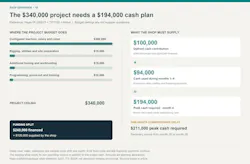
The second infographic shows where the $340,000 goes and why the shop needs $194,000 in available cash before recovery begins. That amount belongs alongside the existing business forecast. It cannot also serve as the reserve for ordinary payroll, rent, supplier bills, and the shop's older equipment payments.
A one-month commissioning delay offers a useful second test. If the sales ramp and variable costs move back together, but staffing, support and financing payments continue, the delay adds $17,000. Peak cash-required rises to $211,000, with recovery moving to month 28. Supplier penalties, rework, or additional integration charges would change that result further.
Before releasing the order, the owner should put names beside the remaining assumptions. Production owns the output schedule. Purchasing owns equipment scope and supplier payment dates. Accounting owns the collection forecast and weekly cash balance. Somebody almost must confirm that the promised customer work is scheduled demand, rather than an estimate of what the customer might buy.
The new contracts make this investment worth examining. A practical approval still needs three numbers on the same page: saleable capacity, cash required through the ramp, and the receipts that will support the payments. If those numbers hold together, the owner can add the machine knowing what the expansion will ask of the rest of the shop.
About the Author
Nathan Abadi
Founder and CEO
Nathan Abadi is the founder and CEO of Excel Capital Management. He focuses on business financing and cash-flow planning.