The Power of Local Manufacturing Marketplaces
Key Highlights
- Engineers and procurement teams naturally default to familiar suppliers, even when local machine shops could deliver better outcomes on cost, quality, and responsiveness
- This tendency is rooted in mental efficiency - we lean toward what we know - and becoming aware of this creates an opening to make better decisions
- Local manufacturing partnerships reduce friction: fewer time zone and translation challenges, faster problem resolution, and easier quality management
- Machine shop operators hold valuable cross-customer insight that buyers rarely access. Surfacing these insights early, at the quote stage or after the first article, can reduce rework and improve job clarity
- Strong local manufacturing ecosystems don't require new infrastructure. They're built through small, consistent habits on both sides of the relationship
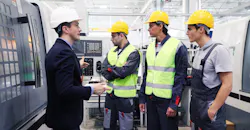
Marketplaces are one of the most powerful and resilient models of doing business. They’re defined by the network effect of making multiple connections between different buyers and sellers which increases opportunity and value. A panel discussion I attended recently illustrated this point, exploring how engineers could better engage with local machine shops to strengthen regional manufacturing communities.
Recently I attended a manufacturing event that included a panel of industry leaders, one of whom was a VP of Engineering for a Massachusetts-based battery manufacturer. When discussing innovation in the industry, he called out the need for closer alignment between engineers and local machine shops. He described the example of an engineer who had developed a new hardware solution and he needed a custom part manufactured. When the VP asked where he was going to source it from, the engineer suggested a vendor in China or a shop in Utah based on a connection he'd made at a trade show. The VP made the point that there are a wealth of local machine shops that could support. Perhaps they weren't marketing as extensively, or may not offer exactly the service on their website, but if engaged they could explore a way to collaborate.
Investing locally, he argued, meant avoiding the cost and friction of translators, different time zones, and related delays. Resolving problems would involve a 30-minute drive and a face-to-face conversation, thereby skipping complicated logistics. This example struck me as important because it touched on two critical observations: we naturally lean toward options that are familiar to us, and secondly, in doing so we may miss the opportunity to step back and consider the overall impact of our decision. These are small misses that add up when we consider them across the scale of an organization.
The familiar path isn't always the best one
Our tendency to lean toward solution options that we are familiar with is well established. In essence, it has its roots in mental efficiency - rather than laboring over every decision, it's more efficient for us to choose what we know or what has worked in the past. This ties to the concept of bias, understood as a "light effort, quick return" means of interpreting a situation and solving for it. Often we discuss bias as a negative but it's grounded in efficiency - our brain has limited resources available to it and it needs to maximize the use of those resources.
Once we are aware of this, that awareness creates an opportunity to explore alternatives that could better achieve our objectives. In the case of the engineer selecting a partner to prepare a custom part, it's likely that the organization's aims were to optimize cost and quality, and that a regional alternative could help to better achieve both of those goals.
Stepping back, when we think about our role within the system of our organization, and even within the regional system or the community of which we're a part, the impact of our decisions gets clearer with context. A quick decision to rely on a machine shop on the other side of the country or the world may resolve the problem that exists right now, but it may add time, cost, and make it more difficult to manage quality.
Further, it may result in underutilized capacity in the regional system. Partnering locally may not always be the ideal option - but it's worth reflecting on whether it yields better results both for the firm and the local manufacturing community.
At the same time, creating and maintaining a thriving local ecosystem involves participation on both sides of the equation - both buyers and sellers, or in this case, engineers and local machine shops. Machine shop owners I've spoken to are exploring how they can efficiently build and maintain quality buyer relationships between jobs and thereby strengthen the local connection.
The hidden cost of transactional relationships
Speaking to machine shop owners, one of the key challenges that has surfaced has been a question of how to engage buyers between job requests. Often they have long-term commercial relationships - they get work - but the interactions can be transactional.
Receive the job, bid on it, produce to requirements, ship it out - then silence until the next order. Once that has become an established pattern, it can be difficult to create an opportunity to learn more about the buyer's broader program, to get a sense of what future work may be required, essentially to build a pipeline.
On the flipside, when the engagement between machine shop and buyers is transactional, poorly defined job requests can become more of an issue. Time and margins are tight and when requirements aren't clear and lead to rework or redesign, or when it's too late to influence a change, both the economics and the buyer's experience can suffer.
Machine shop operators benefit from having a broad view of parts manufactured across multiple buyers and that in itself is valuable insight for a buyer. Certain issues and failure points repeat across parts, jobs, and customers. Tolerances that introduce unnecessary complexity. Design choices that lead to downstream challenges. Situations where a small adjustment early on would have avoided a larger problem later. Those insights can make a meaningful difference for buyers who are often heads-down within their own organization and focused on their product, their parts, and their problems. Packaged simply and efficiently, they can build real connectivity with buyers that lasts beyond the job itself.
Ten minutes at a time
Engaging with buyers by drawing on the insights you already have doesn't need to be time-consuming. A brief note at the quoting stage where something looks likely to cause issues based on similar jobs. A short call after the first article to walk through what actually drove scrap or delay while it’s still fresh. Taking a few minutes after a job to capture what should not be repeated, and sharing that back with the customer once things have settled. Instead of issues being discovered during production, they’re surfaced earlier, when there’s still opportunity to adjust. Engineers get an external view grounded in what’s been seen elsewhere. The result is more clarity in the ask and fewer surprises in execution.
These micro-interactions - ten minutes at a time - can lead to better inputs, smoother execution, and fewer avoidable issues.
Over time, this tends to shift how work comes in. You get pulled into conversations earlier. Inputs improve. Jobs run more cleanly. The commercial side - repeat work, stronger relationships - develops alongside that, but it follows from how the work itself is being shaped.
Marketplaces are at a minimum two-sided, comprised of buyers and sellers, and building and maintaining these communities requires investment on both sides. This doesn't necessarily mean wholly new infrastructure or networking opportunities where neither the money nor the time may be available. It can mean exploring local options before reaching further afield for prototype or parts manufacture.
And it can mean taking ten minutes to provide additional expertise or insight to create goodwill that can strengthen a local connection. A marketplace is only as strong as the habits of its participants - habits that any machine shop can start building today.
About the Author
Chris Bassett
Founder
Chris Bassett is a management consultant with over ten years of experience in operations strategy. He is the founder of Green Bean Consulting Group, which helps leadership teams step outside familiar thinking to tackle complex operational challenges more effectively.
He writes on operational expertise, advanced problem-solving, and building stronger manufacturing businesses.