Lockheed Building More Space Force Satellites
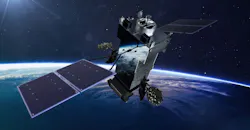
Lockheed Martin has a new $514-million the U.S. Space Systems Command award to manufacture and deliver two more GPS III Follow-On (GPS IIIF) space vehicles, designate Space Vehicles 23 and 24 in connection to a previous contact. The original contract, from 2018, envisioned a total of up to 22 satellites as part of an extensive constellation modernization effort for the U.S. Global Positioning System.
The award covers design, engineering, production, testing, storage, launch support, and on-orbit support of advanced GPS satellites, with multiple options for further satellites to be delivered. The new contract modification brings the total cumulative value of the contract to $4.68 billion.
The work contracted under the current modification will run through November 2032, according to the U.S. Space Systems Command.
Compared to the previous generation of GPS IIIF satellites, the new vehicles are intended to provide greater accuracy; improved anti-jam capabilities; enhanced cybersecurity; longer operating life; and increased flexibility for future upgrades.
Space vehicles 23 and 24 are expected to incorporate newer technologies for “regional military protection (RMP),” with an over 60X increase in anti-jam capability; M-Code encrypted military navigation signals; enhanced cybersecurity protections; and improved power, propulsion, and electronics.
The satellites will be built at Lockheed Martin’s space systems center in Littleton, Col., where it uses a “digital manufacturing approach” that includes primary structural assembly and incorporates the propulsion, avionics, and major subsystems into a unitary space vehicle. The process uses digital twins (virtual spacecraft models) and augmented reality tools for assembly and inspection.
Lockheed also installs navigation payloads, atomic clocks, military M-Code equipment, and search-and-rescue payloads; and performs the vibration, acoustic, thermal-vacuum, electromagnetic compatibility, and functional testing to verify launch readiness.
The Colorado operation also performs launch processing support for the satellites.