
Global steel production rose more than 18 million tons or 11.3% from February to March, ending the month at 159.9 million metric tons across the 69 countries reporting to the World Steel Assn. The improvement however was not enough to top the March 2025 tonnage, the last full month of production before the Trump Administration implemented 25% tariffs on U.S. imports of semi-finished steel and aluminum products.
The trade association also reported steel production during the first quarter of this year (January-March) totaled 459.2 million metric tons, -2.3% less than last year’s comparable figure. In short, steelmakers continue to reduce their output in increments, presumably paring out-of-date or less efficient production capacity.
World Steel’s monthly report tracks carbon steel produced in basic-oxygen or electric arc furnaces and cast into semi-finished forms like billets for bar and rod products; slabs for flat products; or blooms, for beam and pipe products. (Specialty and stainless steel volumes are not included.)
The tariffs, since increased to 50%, remain in place despite the U.S. Supreme Court determining earlier this year that numerous other tariffs were illegally implemented in 2024. And the tariffs have particularly strengthened U.S. steelmakers during the past 12 months.
While the tariffs have not significantly impacted total steel tonnage worldwide, it’s possible that they have curbed excess steel production. The World Steel Economics Committee recently completed a semi-annual forecast for steel consumption, and for the first time in four years it anticipated a slight rise in demand for 2026.
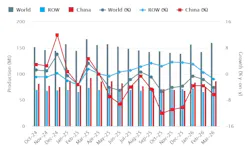
Steel tonnage continues to decline in China, though it remains by far the world’s largest steelmaking nation. During March Chinese steelmakers produced 87.0 million metric tons, 12.5% more than in February - and that represents 54.4% of the total global steel output for the month. Still, it is -6.3% less than China’s March 2025 output, and the country’s January-March total is down -4.6% versus Q1 2025.
Steelmaking in India continues to flourish, with 15.3 million metric tons produced in March, 11.1% more than in February and 9.4% more than in March 2025. The year-to-date tonnage for India is 44.7 million metric tons, 10.8% higher than during January-March 2025.
U.S. steel output during March rose 9.7% from February to 7.2 million metric tons. That represents a 5.2% increase over March 2025, and brings YTD U.S. steel output to 21.0 million metric tons, a 5.7% improvement.
March also saw Japanese steelmakers produce 6.9 million metric tons, a 7.2% increase over February but -4.1% less than the March 2025 result. Their January-March output totaled 20.1 million metric tons, -1.7% less than 2025.
Among other large steel-producing nations, South Korean output picked up 7.4% over February to 5.4 million metric tons during March, which is 1.5% better than March 2025. And it brings South Korean steelmakers to 15.8 million metric tons YTD, 1.8% higher than last year’s Q1 total.
Russian steel output is also estimated at 5.4 million metric tons for March, 11.1% better than February, but that represents an -11.1% decrease from March 2025. It means Russia’s January-March total is estimated at 15.8 million metric tons, which is -10.7% less than the comparable three-month period of 2025.
European Union (27 nations) steel output for March was 11.4 million metric tons, -4.6% year-on-year, and its Q1 total of 31.7 million metric tons is -2.6% lower than last year’s result.
Within that 27-nation total, German steelmakers produced 3.3 million metric tons, 15.2% more than during February and 7.5% more than during March 2025. Germany’s YTD total of 9.3 million metric tons is 9.0% higher than its January-March 2025 result.