Shipbuilder to Apply AI in Real-World Manufacturing
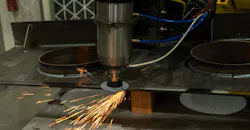
Huntington Ingalls Industries reports it has a memo of understanding to “explore and integrate” physical artificial intelligence (Physical AI) into its shipbuilding operations, anticipating the developments could “accelerate throughput, strengthen the maritime industrial base, and augment the shipbuilding workforce.” HII, a major defense contractor and military shipbuilder, listed autonomous surface preparation, coating, and inspection technologies as manufacturing functions that may be advanced with the availability of Physical AI.
The schedule and financial terms of the MoU were not announced.
Physical AI describes artificial intelligence systems that operate within and interact with the physical world. By drawing insights from AI models with sensors and actuators, “these systems perceive, reason, and act in real-time.”
HII’s partner in the memo is GrayMatter Robotics, a Los Angeles-based developer of Physical AI technologies that conceives and proposes autonomous factories that incorporate “complex, high-mix tool-manipulation applications” for demanding production environments. According to GrayMatter, its proposals are capable of “delivering up to 12x the throughput of skilled manual labor and a 95% reduction in rework.”
GrayMatter Robotics CEO and co-founder Ariyan Kabir stated the partnership with HII aims “to solve difficult problems. We will push to drive down delivery time, build our arsenal, build the essential components for our war fighters, and we have to do this very, very quickly.”
The Trump Administration is pursuing an expansive shipbuilding program for the U.S. Navy; the proposed $1.5 trillion FY 2027 defense budget includes $65.8 billion for shipbuilding projects, to acquire 18 new battle force vessels and 16 non-battle force ships.
Its policies also emphasize the necessity to rebuild commercial shipbuilding capacity, expand the U.S.-flagged fleet, and reduce dependence on foreign-built ships through investments in shipyards and public-private partnerships, as well as potential tariffs.
“We are in the midst of an American shipbuilding renaissance and we are extremely excited to partner with GrayMatter Robotics to explore incorporating their state-of-the-art physical AI models into our shipbuilding operations,” stated Eric Chewning, HII’s executive vice president of maritime systems and corporate strategy.
HII is currently involved in several major U.S. Navy ship series, including the Gerald R. Ford-class aircraft carriers, Virginia-class attack submarines, Columbia-class ballistic missile submarines, Arleigh Burke-class (Flight III) destroyers, and America-class/San Antonio-class amphibious ships.
“Our shipbuilding throughput was up 14% in 2025 and we are looking for an additional 15% increase in 2026,” Chewning continued. “By working with new partners like GMR we can further augment our workforce and speed up U.S. Navy shipbuilding production. I look forward to jointly developing autonomous AI-based manufacturing solutions and integrating them into our High-Yield Production Robotics (HYPR) initiative that leverages physical AI technologies to our shipbuilding processes. Navigating this transformational partnership has the potential to increase our throughput efficiency without sacrificing quality.”
About the Author
Robert Brooks
Content Director
Robert Brooks has been a business-to-business reporter, writer, editor, and columnist for more than 20 years, specializing in the primary metal and basic manufacturing industries.