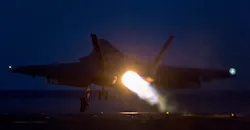
The Pentagon issued a $3.8-billion contract modification to Pratt & Whitney to finalizing contract terms, specifications, and cost for a previously awarded contract for manufacturing a total of 148 F135 engines. The engines will power the current production series - Lot 18 - of F-35 single-engine fighter jets.
Lot 18 will include 148 aircraft that are scheduled for delivery in 2026 and 2027.
Under Pratt’s new award, work will be carried out a various sites in Connecticut, Indiana, and other states. Its completion date is March 2028.
The F135 is an afterburning turbofan engine for the Joint Strike Fighter series, which includes three aircraft models for different takeoff and landing requirements.
The award covers full-rate production of the engines and initial spares, plus engine modules, engineering resources, program oversight, and dedicated production support services, the Pentagon stated. According to the contractor, the award also definitizes contract terms for the following production series, Lot 19, meaning the full value of the contract is more than $6 billion.
Pratt recently announced a $200-million expansion of its Columbus, Ga., military engine manufacturing complex, including additional isothermal forging capacity to support a 30% increase in capacity for critical engine parts, like rotating compressors and turbine disks.
"The F135 is the most advanced military engine in the world, delivering unmatched thrust, reliability and mission readiness for the United States and its allies," stated Pratt & Whitney Military Engines president Jill Albertelli. "Pratt & Whitney is investing heavily across our global production base and supply chain to increase production and accelerate engine delivery and sustainment to meet growing global demand for the F-35 program."
Currently, Pratt & Whitney is carrying out an Engine Core Upgrade (ECU) project to improve the propulsion system capabilities for all three variants of the F135 engine, in anticipation of the U.S. Dept. of Defense’s larger plan to upgrade all three F-35 aircraft models to incorporate more sensor and weapons technologies and electronic warfare capabilities.