Rolls Proposes New Narrow-Body Jet Engine
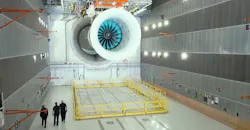
Rolls-Royce reportedly is seeking as much as £200 million ($270 million) in U.K. government assistance to advance the development of a new commercial aircraft engine. The UltraFan 30 would be smaller but parallel version of the UltraFan 80 demonstrator engine, but aimed a the narrow-body jet segment that Rolls-Royce has not served for more than a decade.
The UltraFan 30 is proposed as a propulsion system option for the next generation of single-aisle jets, aircraft that would take the place of the A320neo and 737 MAX series for Airbus and Boeing, respectively.
Rolls’ projection for the overall cost of the UltraFan 30 development is not known.
The engineering group recently staged a presentation with a full-scale mock up to introduce the proposed new engine to potential investors. According to published source, Rolls will seek a government contribution to help fund the development and testing of a demonstrator engine by 2028.
Extending the new engine to production scale would represent a further investment opportunity. Neither Airbus nor Boeing has committed to a new narrow-body jet program, though Airbus is expected to make a “next generation” choice by 2030, and Boeing has indicated it plans to develop a new mid-sized aircraft.
The UltraFan 30 is conceived as a geared turbofan propulsion system, building on the current UltraFan 80 demonstrator in development for the wide-body aircraft segment. Rolls sources explain the new design includes 90-inch diameter fan, lightweight carbon-fiber fan blades, and structural components fabricated from advanced composite materials.
Rolls-Royce initiated the UltraFan program more than 10 years ago, and the demonstrator engine is assembled and undergoing testing in Derby, England, at full power and running on Sustainable Aviation Fuel (SAF.)
The group expects the proposed new engine UltraFan 30 to deliver 30% greater fuel efficiency and lower emissions than its first-generation Trent engines, with about 30,000 lbs. of engine thrust.
Ground testing of UltraFan 30 would be run as a separate demonstrator, pointing toward flight testing in the late 2020s. That schedule could be compatible for entry into service with new aircraft in the 2030s.