Global steel production is on track to drop for the fourth consecutive year, as the eleven-month output for 2025 now totals 1.66 billion metric tons, down -2.0% from the January-November 2024 result, according to the World Steel Assn. Many of the same conditions that contributed to the past annual declines continue to affect steel output worldwide, including weak industrial demand and slow construction activity.
One factor that has influenced the global steel market is the enactment of U.S. tariffs on steel imports since April, which has resulted in rising output by domestic steelmakers.
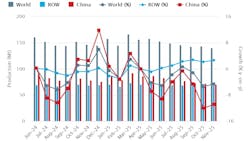
Monthly production totals for November reflect the current state of the global industry and the trends shaping it. For the 70 countries tracked by World Steel Assn., November raw steel production totaled 140.1 million metric tons; it was the lowest monthly production total of 2025, a -2.3% decline from October production and a -4.6% drop from November 2024.
In October, World Steel Assn. published its semi-annual outlook for steel consumption, forecasting no rise in demand for the current year, and only a modest improvement in demand through 2026.
World Steel’s chief economist Alfonso Hidalgo de Calcerrada explained that global manufacturing activity is impaired by “elevated production costs and sustained affordability pressures on consumers”. He said an additional strain is brought by increasing tension in global trade and the resulting “direct, negative impact on steel demand in economies heavily reliant on the export of steel-intensive goods, such as machinery and automotive components.”
Supply-chain disruptions and regional conflicts also contributed to weak steel demand.
The steel industry in China consistently shapes the overall results, as that country produces more than half of all raw steel produced worldwide. However, the industry has long been the object of Chinese regulators efforts to consolidate excess capacity, and in recent years has been beset with weakening domestic industrial activity and a struggling construction sector.
Chinese raw-steel output in November was 69.9 million metric tons - roughly half of the world’s total last month - which was -3.0% less than the October total and -10.9% less than the November 2024 result. Through 11 months of production, China’s steel industry has produced 891.7 million metric tons of raw steel, or about 53.0% of the total global output for the year-to-date. That represents a -4.0% year-over-year decrease for the Chinese producers.
The Indian steel industry offers a different view: the nation rose to the world’s number-two producer of raw steel in 2018, but it became a net-exporter of steel for the first time in October of this year. During November, Indian steelmakers produced 13.7 million metric tons of raw steel, nearly 10.0% of the global output for the month. The total is roughly even (+0.7%) with the October total, but 10.8% more than last November’s result.
For the current year to-date, the Indian steel industry has produced 150.1 million metric tons of raw steel, 9.0% of the world’s total, and 10.3% more than last year’s January-November total.
An important development in the global steel market during 2025 was the U.S. industry stabilizing its output, and in May surpassing Japan for the number-three rank among steel-producing nations. During November, U.S. steelmakers produced 6.8 million metric tons of raw steel, -2.9% less than during October but 8.5% more than the November 2024 result. For the year-to-date, U.S. steelmakers have produced 75.1 million metric tons of raw steel, or 3.2% more than during January-November 2024.
Japan, now ranking fourth among the world's largest steelmaking nations, produced 6.8 million metric tons during November, -1.5% less than during October and -1.6% less than November 2024. For 11 months of 2025, Japanese producers have produced 74.1 million metric tons, -3.9% less than last year’s comparable total.
Steel production also fell in Russia - 5.2 million metric tons during November (down -1.9% from October, -6.6% from November 2024), bringing the year-to-date to an estimated 61.8 million metric tons, -5.5% less than January-November 2024.
In the European Union, including Germany, the eight-largest steel-producing nation, November yielded 10.2 million metric tons of raw steel, which was -3.5% less than last November. The region has produced 116.1 million metric tons for the year to-date, which is -3.3% less than last year.
The monthly World Steel report on raw-steel production documents carbon steel produced in basic-oxygen or electric arc furnaces and cast into semi-finished forms like billets for bar and rod products; slabs for flat products; or blooms, for beam and pipe products. Specialty and stainless steel volumes are not included.
About the Author
Robert Brooks
Content Director
Robert Brooks has been a business-to-business reporter, writer, editor, and columnist for more than 20 years, specializing in the primary metal and basic manufacturing industries.