Hybrid Machining is Growing, and Shops’ Opportunities are Expanding
Key Highlights
- Hybrid machining combines additive and subtractive processes in a single set-up, improving accuracy and reducing errors associated with transferring parts between machines.
- Advances in software and process control allow for unified programming, simulation, and optimization of complex manufacturing sequences from a single digital model.
- Material selection has broadened, with premium alloys deposited only where needed, reducing costs and enhancing component performance.
- In-process inspection and thermal monitoring enable adaptive machining strategies, improving quality, reducing waste, and ensuring compliance with industry standards.
- Hybrid manufacturing supports repair, customization, and near-net-shape production, offering significant advantages for high-value industries like aerospace, medical, and tooling.
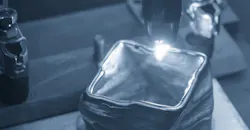
Less than 20 years ago, a visitor to IMTS could marvel at the linking of CNC milling and EDM processes, conceived by developers so that precision mold products or custom orthopedic implements could be produced in a single, programmable workflow.
Now, what we vaguely call “hybrid machining” is growing out of its label - one settled on in that recent past to characterize a range of processing combinations that borrowed from laser-based additive manufacturing and “subtractive manufacturing” to create distinctive production sequences. What else would developers have called that in 2016?
Hybrids are evolving
Visitors to IMTS 2026 will find numerous hybrid machining possibilities offered by CNC machine builders, laser process specialists, and their development partners. And they’ll realize that hybrid machining is moving beyond early adoption and into practical production. Advances in machine integration, software, and process control are making hybrid manufacturing accessible not just to aerospace manufacturers and industrial researchers - but to shops focused on tooling, repair, and high-value, low-volume production.
One of the most notable developments in 2026 is improved integration between additive and subtractive operations. Today's hybrid machine tools can alternate between depositing metal and machining finished features with minimal operator intervention, reducing set-up changes and maintaining part alignment throughout the manufacturing process. Keeping the workpiece in a single set-up improves positional accuracy while eliminating the cumulative errors that can occur when parts are transferred between separate machines.
Hybrid Machining Choices
In the wide world of manufacturing technology, hybrid machining describes systems that link additive manufacturing (typically directed energy deposition, (DED) using powder or wire) with CNC milling and/or turning in a single set-up.
These are some of hybrid machining systems offered by notable CNC machine developers:
|
Builder |
Hybrid machining platform |
Additive process |
Machining capability |
Typical applications |
|
LASER EX Series |
Laser metal deposition (powder) |
Five-axis milling, multitasking, grinding |
Mold repair, aerospace, dies, tooling |
|
|
LASERTEC 65/125/3000 3D Hybrid |
Laser metal deposition |
Five-axis milling or mill-turn |
Aerospace, turbine components, repair, medical |
|
|
INTEGREX i-AM / Hybrid multi-tasking |
Laser cladding (powder) |
Multi-tasking turning + milling |
Large aerospace parts, repair, energy |
|
|
LUMEX Avance Series |
Powder bed fusion |
High-speed milling |
Mold making, conformal cooling, precision tooling |
|
|
Hybrid series |
Laser DED (wire and powder) |
Five-axis CNC milling |
Multi-material parts, repair, research |
|
|
AM1 |
Blown-powder DED |
CNC milling |
Materials R&D, repair, tooling, university labs |
One of the most notable developments in 2026 is improved integration between additive and subtractive operations. Today's hybrid machine tools can alternate between depositing metal and machining finished features with minimal operator intervention, reducing set-up changes and maintaining part alignment throughout the manufacturing process. Keeping the workpiece in a single set-up improves positional accuracy while eliminating the cumulative errors that can occur when parts are transferred between separate machines.
Machine builders have improved calibration between deposition systems and machining spindles too, so that material placement is more precise and less stock is needed for finish machining. In many applications, this means shorter cycle times and lower material consumption.
Programming additive + subtractive
Naturally, the advances are possible because software has evolved too. Several CAM platforms support unified programming for additive and subtractive operations, allowing manufacturers to develop complete process plans from a single digital model. Deposition paths, machining toolpaths, and inspection routines can be simulated together, helping programmers identify collisions, verify tool access, and optimize manufacturing sequences before production begins.
Material selection continues to broaden as well. Tool steels remain a common choice for rebuilding worn dies, molds, and cutting tools; stainless steels support corrosion-resistant industrial components. Nickel-based superalloys continue to drive repair applications in aerospace and energy, where replacing large, high-value components is often cost-prohibitive.
Titanium alloys remain an important material for lightweight structural components and medical applications.
An emerging advantage of hybrid manufacturing is the ability to place premium materials only where they deliver the greatest benefit. Instead of machining an entire component from an expensive alloy, manufacturers can deposit wear-resistant or heat-resistant material onto localized areas while producing the remainder of the part from a more economical substrate. This targeted material strategy can improve component performance while reducing overall material costs.
Beyond conventional machining
For CNC job shops, these capabilities create opportunities that extend beyond conventional machining. Hybrid systems support the repair of damaged tooling and production components, reducing lead times and extending the service life of expensive assets. Engineering changes can be incorporated by adding material to existing parts rather than starting from raw stock, while near-net-shape manufacturing minimizes material removal during finish machining.
Programming hybrid jobs requires manufacturers to consider factors that do not exist in conventional machining. Deposition parameters, layer sequencing, thermal management, and the timing of machining operations all influence final part quality. Many manufacturers rely on digital twins and process simulation to validate both additive and subtractive operations before setting up on the shop floor, to reduce process risk and improve first-pass success rates.
Monitoring the processes
Inspection is another manufacturing step that has become an element of hybrid manufacturing. In-process probing, laser scanning, and optical measurement systems allow manufacturers to verify deposited geometry before finish machining begins. Rather than treating inspection as a final quality check, hybrid systems increasingly use measurement data to guide adaptive machining strategies that compensate for deposition variability.
Thermal monitoring is also becoming a feature for hybrid platforms. By tracking heat input during deposition, manufacturers can better predict distortion, manage residual stresses, and adjust machining offsets as conditions change. Combined with comprehensive process data and inspection records, these capabilities strengthen traceability for industries with demanding quality and regulatory requirements.
Hybrid machining technologies have evolved steadily in the past decade, becoming a practical production tool rather than a specialized manufacturing process. For shops serving aerospace, energy, medical, tooling, and other high-value markets, hybrid manufacturing offers a way to expand capabilities, improve material efficiency, and deliver complex components without compromising the precision and surface finish that remain the hallmarks of CNC machining.
About the Author
Robert Brooks
Content Director
Robert Brooks has been a business-to-business reporter, writer, editor, and columnist for more than 20 years, specializing in the primary metal and basic manufacturing industries.