What Are the Robots Doing Now?
Key Highlights
- AI allows robots to operate independently, predict failures, and learn new tasks.
- The convergence of IT and OT makes robots more versatile via real-time data exchange, supporting digital enterprise capabilities / Industry 4.0.
- Humanoid robots match human dexterity and productivity, increasingly in real-world manufacturing.
- Safety and security concerns demand strict standards, cybersecurity measures, and clear liability frameworks.
- Automation helps address skills and labor shortages, but require cooperation between employers and workers.
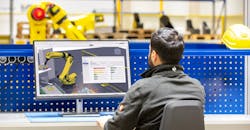
Technological trends are converging as automation expands its presence in manufacturing, and according to a global research group the emergence of new technologies will motivate the next wave of industrial automation. The International Federation of Robotics - which noted that the global market value of industrial robot installations recently hit $16.7 billion, a record - identified five factors that will drive investments in automation this year.
1. AI proliferates
Automation devices (i.e., robots) that work independently thanks to artificial intelligence to work independently are becoming more common.
Of course, there are different types of AI and each one imparts particular benefits, according to manufacturers’ needs. Analytical AI uses machine learning, statistics, and data mining to process large volumes of data, identifying patterns that can inform actions. It focuses on predicting outcomes, optimizing processes, and aiding decision-making. In manufacturing, analytical AI allows robots to anticipate breakdowns or failures, autonomously, before they disrupt operations in smart factories; or path planning and resource allocation in logistics.
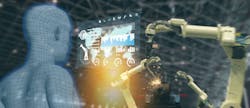
Generative AI uses machine learning models trained on expansive datasets to learn underlying patterns: when prompted, the platform can use its learned patterns to generate distinct, “human-like” responses. In the scope of manufacturing, GenAI marks a shift from rule-based automation to intelligent, self-evolving systems.
GenAI creates new outputs and allows robots to learn new tasks autonomously, and generate training data through simulation. It also allows a new type of human–robot collaboration, using with natural language and vision-based commands.
Last, and according to IFR a critical trend for autonomous robots is agentic AI. This emerging capability involves systems that act independently to achieve specific, complex goals with minimal human intervention. Unlike standard AI that locates and reports content, agentic AI uses complex reasoning, planning, and external tool access to perform sequential tasks, demonstrating proactivity, self-correction, and adaptation to new information
For manufacturing, agentic AI combines analytical AI for structured decision-making, and generative AI for adaptability. According to IFR, this hybrid approach could lead to robotic systems capable of working independently in complex operations.
2. Versatility rises
Every manufacturer is being made aware of the increasing importance of versatility - among personnel, with machinery, and in technology. Demand for versatile robots is accelerating, directly reflecting a technological convergence of information technology (IT) and operational technology (OT).
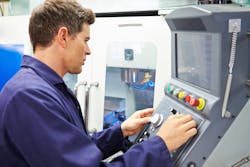
This conjunction of data-processing power (IT) and physical control capabilities (OT) enhances robotic versatility through real-time data exchange, automation, and advanced analytics. The integration is becoming a foundation of digital enterprises and Industry 4.0 capability.
According to IFR, the IT/OT convergence breaks down silos and makes it possible for manufacturing data to flow between the digital and physical worlds, which significantly enhances the capabilities and versatility of robots.
3. Rise of the humanoids
Machines designed to resemble human bodies, built to operate in human surroundings, and to interact with human tools, are developing quickly. These humanoid robots combine artificial intelligence, sensors, and actuators to perform tasks, walk, and interact with “socially” workers.
These robots are engineered to navigate space, including changing elevations and workplace safe zones. Many of them use AI to perceive surroundings and make decisions.
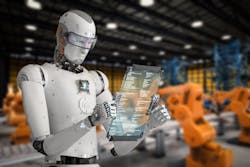
In manufacturing, humanoid robots are being proposed as flexible technology, able to function in settings and activities conceived as human tasks. The automotive industry has been out front in applying humanoid robots, as IFR notes, with applications in warehousing and manufacturing emerging now.
In 2026, businesses and developers are moving beyond prototypes to deploy humanoids in actual workplace functions. Reliability and efficiency are critical. To compete with standard robotic automation, humanoid robots need to match industrial requirements involving cycle times, energy consumption, and maintenance costs. Industry standards also define safety levels, durability criteria and consistent performance of humanoid robots needed on the factory floor.
Humanoid robots are intended to fill labor gaps in order to achieve human-level dexterity and productivity, to prove real-world efficiency.
4. Safe and secure
With increasing frequency, in manufacturing and service centers robots are being put to work alongside humans, so devices operating safely is essential for robot suppliers. AI-driven autonomy is changing the safety scenario, and IFR reports that makes testing, validation, and human oversight more complex and more necessary. To implement humanoid robots, for example, robotic systems must be designed and certified in line with ISO safety standards and clearly defined liability frameworks.

More than that, in regard to AI in robotics and IT/OT combo, a new range of safety and security concerns is emerging. These new standards must be defined and applied clearly.
“The rapid expansion of robotics systems into cloud-connected and AI-driven environments is exposing industrial production to a growing array of cybersecurity threats,” IFR reported. Incidents of hacking attempts targeting robot controllers and cloud platforms show the potential for unauthorized access and potential system manipulation.
As robots are integrated further into more workplaces, concerns increase over the sensitivity of the data they collect (e.g., video, audio, and sensor streams.) Deep-learning models (aka, black boxes) can produce results that are difficult or impossible to explain, even to the developers.
Legal and ethical ambiguity surrounding liability has prompted calls for clear frameworks to govern AI deployment, according to IFR.
5. Filling open positions
The skills gap is a shortage of expertise in manufacturing, but it’s also a labor shortage. Employers worldwide struggle to find people with specialized skills, and to retain them once they’re found. The current workers cover extra shifts, raising workplace stress and worker fatigue.
Manufacturers’ one effective response is adopting automation and robotics. When this is done successfully, the cooperation between employers and employees in implementing robots proves to be critical.
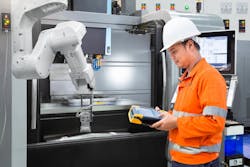
More than that, in regard to AI in robotics and IT/OT combo, a new range of safety and security concerns is emerging. These new standards must be defined and applied clearly.
“The rapid expansion of robotics systems into cloud-connected and AI-driven environments is exposing industrial production to a growing array of cybersecurity threats,” IFR reported. Incidents of hacking attempts targeting robot controllers and cloud platforms show the potential for unauthorized access and potential system manipulation.
As robots are integrated further into more workplaces, concerns increase over the sensitivity of the data they collect (e.g., video, audio, and sensor streams.) Deep-learning models (aka, black boxes) can produce results that are difficult or impossible to explain, even to the developers.
Legal and ethical ambiguity surrounding liability has prompted calls for clear frameworks to govern AI deployment, according to IFR.
5. Filling open positions
The skills gap is a shortage of expertise in manufacturing, but it’s also a labor shortage. Employers worldwide struggle to find people with specialized skills, and to retain them once they’re found. The current workers cover extra shifts, raising workplace stress and worker fatigue.
Manufacturers’ one effective response is adopting automation and robotics. When this is done successfully, the cooperation between employers and employees in implementing robots proves to be critical.