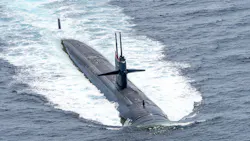
The U.S. Navy announced March 20 that Hadrian had opened a new factory in Cherokee, Alabama intended to boost submarine production. The $2.4 billion, 2.2-million square foot Factory 4 site was funded by $900 million from the Navy and $1.5 billion in private investments. The company says the site is expected to create 1,000 new jobs at the site and reach full production between 18-24 months.
Hadrian is a venture-backed manufacturing company that explains it aims to “re-industrialize” the U.S. by building highly automated, software-driven factories for aerospace and defense. Using AI, robotics, and proprietary software (Opus), Hadrian produces precision components for rockets, satellites, and defense systems.
The Alabama plant, Hadrian’s fourth manufacturing location, will mass produce parts for Virginia-class attack submarines and Columbia-class ballistic missile subs. According to Secretary of the Navy John C. Phelan, three more such plants are planned.
According to the Navy, the dedicated plant will free up space at other sub plants on the East Coast to focus on submarine modules and increase overall production. In a statement, Jason Potter, Acting Assistant Secretary of the Navy for Research, Development & Acquisition, said the new plant would smooth the process by dividing labor.
“We call this distributed shipbuilding, and it’s a key tenet of our plan to achieve required shipbuilding production rates,” Potter said. “These factories of the future might be several states away from the yards where the ships are ultimately built, but by taking on this work they reduce bottlenecks, having a profound effect on the speed of delivery.
In a statement, Secretary Phelan credited Congress with passing the funds necessary for the plant in the Trump Administration’s signature One Big Beautiful Bill Act.
“Both chambers of Congress delivered the generational investment required to rebuild our shipbuilding capacity, bring those jobs back to Alabama and put American skilled laborers back at the center of American strength,” Secretary Phelan said. “I look forward to building on this progress together in the months ahead, because we are just getting started. This factory is the first of three facilities designed to address the most critical bottlenecks in the maritime industrial base.”
About the Author
Ryan Secard
Ryan Secard joined Endeavor B2B in 2020 as a news editor for IndustryWeek. He currently contributes to IW, American Machinist, Foundry Management & Technology and Plant Services on breaking manufacturing news, new products, plant openings and closures, and labor issues in manufacturing.