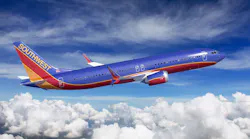
The Federal Aviation Administration has concluded that a software defect in some Boeing 737 MAX flight-management systems is not a safety concern. The issue was discovered by Boeing in August and reported to FAA and 737 MAX operators.
The wider significance of the issue was the pending FAA-certification of the 737 MAX 10, the largest variant of Boeing’s narrow-body jet series.
“Following a thorough review, a panel of FAA safety experts on Friday determined a software issue in certain Boeing 737 MAX flight computers is not a safety concern,” the FAA stated on October 2. “The FAA’s Corrective Action Review Board made that determination because pilots retain full control of the aircraft and the indications to the flight crew are clear and unambiguous.”
Boeing earlier explained the issue could cause an aircraft’s automated vertical navigation (VNAV) system to fail unexpectedly during a missed approach or reapproach, if the flight crew alters the pre-programmed flight path. In those instances, pilots are instructed to execute further procedures in order to use automated tools on subsequent approaches.
No airline operators are known to have reported adverse incidents related to the issue, which affects versions 14 and 14.1 of the VNAV software. Earlier versions of the program are not affected.
Whether the FAA’s pass on the VNAV issue will speed up its certification of the MAX 10 is unknown. Boeing had been anticipating that FAA clearance before the end of this year, signaling to analysts that deliveries (and thereby, revenues) would follow in course.
The smallest version of the series, the 737 MAX 7, won FAA approval in early August.
Boeing has booked over 1,400 orders from major carriers, including Alaska Airlines, American Airlines, Delta Air Lines, Ryanair, and United Airlines.