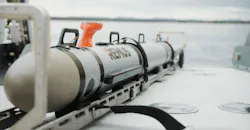
Defense contractor Huntington Ingalls Industries completed a 25% expansion of a Massachusetts plant where it builds, develops, and integrates unmanned maritime systems. The Pocasset, Mass., operation now covers 50,000 square feet, with additional production capacity for the U.S. Navy’s Lionfish small unmanned undersea vehicle, which is based on HII’s Remus 300 UUV (unmanned undersea vehicle) platform.
Along with the Remus UUVs, the plant builds HII’s Romulus unmanned surface vehicles (USVs.)
HII employs about 300 people at Pocasset, having added 50 since the start of this year.
The USN renewed its order for the Lionfish vehicles, the second option year in a five-year program that could total up to 200 units and exceed $347 million in total value.
Manufactured by HII at Pocasset, the Lionfish is the first uncrewed undersea platform that the USN has transitioned from rapid prototyping to full-rate production. It is built on the commercial-grade Remus 300 platform, and has a modular, open-architecture design that allows operators to update the payload according to the mission requirements.
Lionfish autonomous subsea drones are used for mine countermeasures; intelligence, surveillance, and reconnaissance; anti-submarine warfare; and electronic warfare operations. It’s described as the U.S. military's first and only, fully cyber-compliant uncrewed underwater vehicle, protecting transmission data versus electronic warfare threats.
Remus UUVs have commercial applications too, including oceanographic research and environmental monitoring.
HII’s plant expansion also will promote integration of HII’s Odyssey Autonomous Control Solutions (ACS) software, which supports advanced autonomous and unmanned maritime operations; as well as autonomy hardware for Romulus USVs. The ACS software is used to simulate and model complex missions across multiple domains and vehicle types.
“Today’s expansion reflects HII’s continued investment in the people, technology and partnerships that have made us a leader in unmanned maritime capabilities and placed New England at the center for maritime innovation,” stated Duane Fotheringham, president of the Unmanned Systems group in HII’s Mission Technologies division. “By bringing together advanced unmanned platforms, autonomy, integration, simulation and modeling capabilities, we are expanding our ability to deliver the maritime systems our customers need while continuing to create high-quality jobs here in Massachusetts.”
The cost of the expansion was not announced.